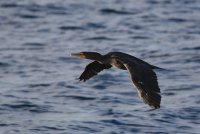
Brandt's Cormorant (Phalacrocorax penucillatus)

PNWPhotos.com a friendly and growing community of photographers with an interest in the Pacific Northwest region. We feature a Photography Discussion Forum and Pacific Northwest Photo Gallery. It's a fun and friendly place to talk with other photographers, ask questions, share you knowledge, view and post photos and more!


Deka

Member
A Cormorant and I don't know which one! LOL

I welcome the warming sun.
#6293bcr.jpg

I believe that this is a juvenile, but I could be wrong. LOL
The feather structure under the wings is very interesting.

Deka

Edited to be funny and make fun of my inability to correctly identify birds! LOL
Thank you to all that keep me on the straight and narrow path of bird identification. :rolleyes:
 
Last edited:
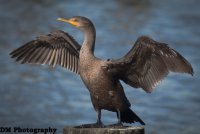
I believe it is a double-crested cormorant (Phalacrocorax auritus), the most common cormorant in the Puget Sound region. The large photo in this link shows one in mating plumage: http://birds.audubon.org/birds/double-crested-cormorant

Unlike some water birds, cormorants have very little oil in their feathers to repel water. This creates a lack of buoyancy which enables the cormorant to dive easier. The lack of oil also means that they must periodically spread their wings out to dry so they don't become waterlogged. Their numbers will increase along Puget Sound during the winter, so you will have lots of opportunities to photograph them. Try capturing their "walking on water" take-offs.
 
Last edited:


I believe it is a double-crested cormorant (Phalacrocorax auritus), the most common cormorant in the Puget Sound region. The large photo in this link shows one in mating plumage: http://birds.audubon.org/birds/double-crested-cormorant

Unlike some water birds, cormorants have very little oil in their feathers to repel water. This creates a lack of buoyancy which enables the cormorant to dive easier. The lack of oil also means that they must periodically spread their wings out to dry so they don't become waterlogged. Their numbers will increase along Puget Sound during the winter, so you will have lots of opportunities to photograph them. Try capturing their "walking on water" take-offs.

Well Fudge! Mac's Field Guide is wrong!
Being dependent upon identification guides, it makes me wrong as well.
So sorry!
I'm getting the reputation of the 'mis-identifications'.
Hopefully, others can learn from my mistakes. LOL
Sometimes the best way to learn is to make a mistake.

Deka
 
Thank you Debbie.
A fall mid-day shot.
Not the best time to be out with the camera but the best time to catch the birds. LOL

Deka
 
I really like the lighting! What time of day did you take this?


Chad

Believe it or not, this was taken around 12:30 pm.
The morning was overcast and then the sun came out around lunch time.
I think the angle of the fall sun and the tide really adds to an image.

Deka
 
Well Fudge! Mac's Field Guide is wrong!
Being dependent upon identification guides, it makes me wrong as well.
So sorry!
I'm getting the reputation of the 'mis-identifications'.
Hopefully, others can learn from my mistakes. LOL
Sometimes the best way to learn is to make a mistake.

Deka

I continue to mis-identify birds. I recommend Birds of the Puget Sound Region by Robert Morse. It contains nearly 99.9% of the birds you will see locally and is small enough to fit in your pocket. Leave the Sibley's at home, as there is no sense in lugging around a heavy bird book which contains hundreds of birds not found in our area.
http://www.rwmorse.com/birdsofps/images.html

Here is a photo of a double-crested cormorant I took Monday (10/20/14) afternoon from the fishing pier at the Edmonds marina.
11.JPG
 
Last edited:


Affiliate Disclosure: We may receive a commision from some of the links and ads shown on this website (Learn More Here)

Back
Top