
You are using an out of date browser. It may not display this or other websites correctly.
You should upgrade or use an alternative browser.
You should upgrade or use an alternative browser.
Wildlife of Edmonds, WA.
- Thread starter Bill Anderson
- Start date
PNWPhotos.com a friendly and growing community of photographers with an interest in the Pacific Northwest region.
We feature a Photography Discussion Forum and Pacific Northwest Photo Gallery. It's a fun and friendly place to talk with other photographers, ask questions, share you knowledge, view and post photos and more!

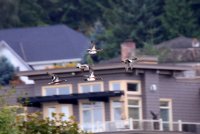
It is but one example of why I literally keep my camera beside me in the pickup. I noticed the geese as Daren and I were driving past the soccer field on my way to dropping him off at the tennis club. I thought to myself, "Those don't look like the usual Canada geese we see in the park and they don't look like ducks."
There were still a few minutes before Daren had to be at the tennis club, so I parked the pickup, grabbed my camera, and slowly walked over to the fence to check them out. Many people in western Washington have recently reported seeing flocks of white-fronted geese, so the fall migration must be on en force.
Be careful what you say. My head may swell up so large that my signature WSU/Cougar ball cap visible in my avatar won't fit.
Affiliate Disclosure: We may receive a commision from some of the links and ads shown on this website (Learn More Here)

Very cool you spotted those Geese, Bill. I probably would have driven right by!
It is but one example of why I literally keep my camera beside me in the pickup. I noticed the geese as Daren and I were driving past the soccer field on my way to dropping him off at the tennis club. I thought to myself, "Those don't look like the usual Canada geese we see in the park and they don't look like ducks."
There were still a few minutes before Daren had to be at the tennis club, so I parked the pickup, grabbed my camera, and slowly walked over to the fence to check them out. Many people in western Washington have recently reported seeing flocks of white-fronted geese, so the fall migration must be on en force.
Last edited:
My usual local avian photo locations were pretty dead on Tuesday (9/24), but I found some action in my backyard.
These shots were taken in bright morning sunlight streaming in from behind me with resulting low ISO settings.
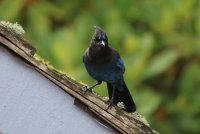
Steller's jay. I think it was upset at my cat as it kept squawking and looking down at the ground.
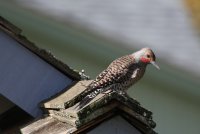
Red-shafted northern flicker. They are going through my suet feeder like crazy.
These shots are a little soft, as they were taken in late afternoon overcast shade with an ISO setting of 12800. They were taken relatively close up from the ground and not from the the 2nd story back deck like the previous shots.
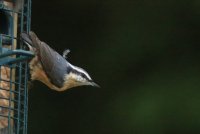
Red-breasted nuthatch, one of my favorite backyard birds.
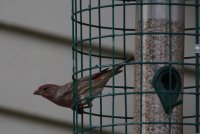
Juvie male house finch.
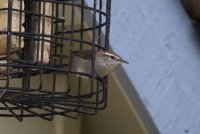
Bewick's wren, another of my favorite backyard birds.
These shots were taken in bright morning sunlight streaming in from behind me with resulting low ISO settings.
Steller's jay. I think it was upset at my cat as it kept squawking and looking down at the ground.
Red-shafted northern flicker. They are going through my suet feeder like crazy.
These shots are a little soft, as they were taken in late afternoon overcast shade with an ISO setting of 12800. They were taken relatively close up from the ground and not from the the 2nd story back deck like the previous shots.
Red-breasted nuthatch, one of my favorite backyard birds.
Juvie male house finch.
Bewick's wren, another of my favorite backyard birds.
Last edited:
Some morning shots of tree rats, aka invasive eastern gray squirrels, in my backyard.
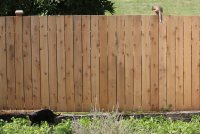
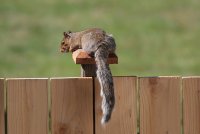
One was sunning itself on a fence post while keeping an eye on my cat.
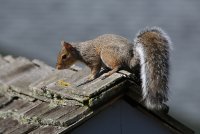
A second one was on the roof of my shed in its continual quest to raid my bird feeders.
It jumped off the shed and walked along the fence........
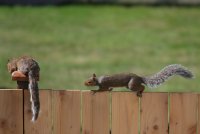
then jumped down to the ground rather than risk upsetting the one which was already on the fence post. The squirrels get more upset at each other than they do with my cat.
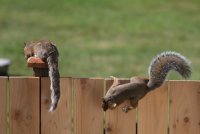
One was sunning itself on a fence post while keeping an eye on my cat.
A second one was on the roof of my shed in its continual quest to raid my bird feeders.
It jumped off the shed and walked along the fence........
then jumped down to the ground rather than risk upsetting the one which was already on the fence post. The squirrels get more upset at each other than they do with my cat.
Last edited:

Some birds from Wednesday 9-25-13.
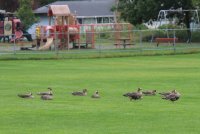
The white-fronted geese continue to hang at at the Lake Ballinger Park playfield in Mountlake Terrace.
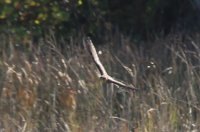
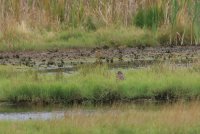
Something was flying around the far south side of the marsh in an unusual pattern. I think it was a peregrine falcon. This is the best shot I got.
Edit: I e-mailed this and my 18 other (admittedly poor) photos of the bird to a local falcon expert. He believes it is a female merlin.
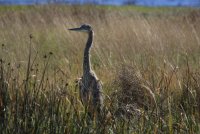
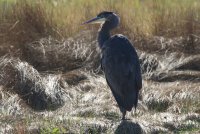
I think this is a juvie great blue heron based on the lack of really long feathers on its head and breast.
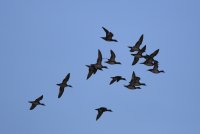
The fall migration has started with ducks continually flying to and from the marsh.
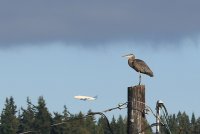
I caught this great blue heron perched on a pole at the marsh with Boeing's Dreamliner in the background.
The white-fronted geese continue to hang at at the Lake Ballinger Park playfield in Mountlake Terrace.
Something was flying around the far south side of the marsh in an unusual pattern. I think it was a peregrine falcon. This is the best shot I got.
Edit: I e-mailed this and my 18 other (admittedly poor) photos of the bird to a local falcon expert. He believes it is a female merlin.
I think this is a juvie great blue heron based on the lack of really long feathers on its head and breast.
The fall migration has started with ducks continually flying to and from the marsh.
I caught this great blue heron perched on a pole at the marsh with Boeing's Dreamliner in the background.
Last edited:
The hummers at the #1 platform of the marsh continue to put on a show.
Check the lower left and upper right corners of the photo.
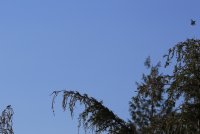
There were lots of small flying bugs in the air. It was hard to tell if the two hummers were feeding or squaring off.
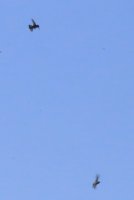
No doubt that the chase is on.
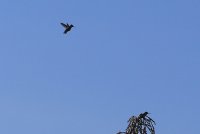
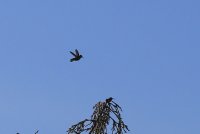
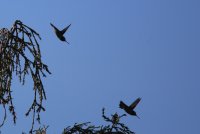
Check the lower left and upper right corners of the photo.
There were lots of small flying bugs in the air. It was hard to tell if the two hummers were feeding or squaring off.
No doubt that the chase is on.
Although I found nothing note-worthy at the usual locations on Thursday (9/26), I tried to pull off some artsy shots to keep everyone entertained.
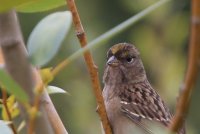
All of us (or those of us of Midwestern heritage, anyway) have heard the saying, "As scarce as hens' teeth." Up on the Pt. Edwards walkway, a golden-crowned sparrow appeared to have an artsy tooth growing out of its lower bill.
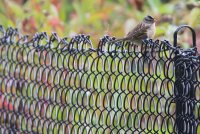
A bird perched on a chain link fence + a telephoto lens always makes for an artsy shot. A white-crowned sparrow near the retention pond at the end of the walkway was only too happy to oblige.
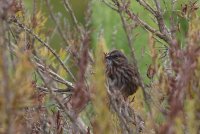
Song sparrows are pretty common place, but this one looked artsy when hiding within leafless foliage.
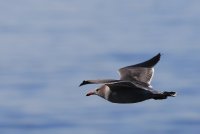
Heermann's gulls are autumn visitors to our area. This one flew past the fishing pier in artsy fashion.
Although it is a regular inhabitant of the marsh, a great blue heron can look artsy when photographed in the late afternoon back lighting with my super telephoto setup of 7D + 2.8/400L telephoto lens + 1.4x teleconverter.
All of us (or those of us of Midwestern heritage, anyway) have heard the saying, "As scarce as hens' teeth." Up on the Pt. Edwards walkway, a golden-crowned sparrow appeared to have an artsy tooth growing out of its lower bill.
A bird perched on a chain link fence + a telephoto lens always makes for an artsy shot. A white-crowned sparrow near the retention pond at the end of the walkway was only too happy to oblige.
Song sparrows are pretty common place, but this one looked artsy when hiding within leafless foliage.
Heermann's gulls are autumn visitors to our area. This one flew past the fishing pier in artsy fashion.
Although it is a regular inhabitant of the marsh, a great blue heron can look artsy when photographed in the late afternoon back lighting with my super telephoto setup of 7D + 2.8/400L telephoto lens + 1.4x teleconverter.
Last edited:
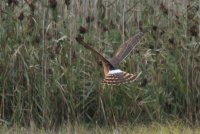
Although the Edmonds marsh seems like a good habitat for northern harriers and short-eared owls, I have only seen a short-eared owl once at the marsh. I see northern harriers a little more often, about once a year. I suspect the local crows play a large part in discouraging the owls and harriers from taking up permanent or seasonal residency.
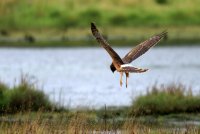
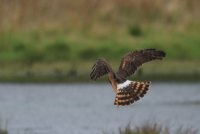
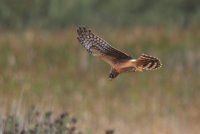
Friday (9/27) afternoon a female northern harrier flew into the marsh from the north and spent about 40 minutes hunting the marsh. She rested for about five minutes and then continued her journey south around Pt. Edwards. I used two combinations of lenses and cameras to photograph her. All of the shots are cropped.
7D + 2x teleconverter + 2.8/400L (tripod mounted) = 1251mm/35 mm equivalent. This combo has reach, but not clarity.
Note the spider web stuck on the harrier's left wingtip.
The harrier spent about five minutes resting and grooming herself.
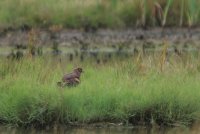
Friday (9/27) afternoon a female northern harrier flew into the marsh from the north and spent about 40 minutes hunting the marsh. She rested for about five minutes and then continued her journey south around Pt. Edwards. I used two combinations of lenses and cameras to photograph her. All of the shots are cropped.
7D + 2x teleconverter + 2.8/400L (tripod mounted) = 1251mm/35 mm equivalent. This combo has reach, but not clarity.
Note the spider web stuck on the harrier's left wingtip.
The harrier spent about five minutes resting and grooming herself.
Last edited:
5D Mk III + 1.4x teleconverter + 100-400L zoom (handheld) = 544mm/35mm equivalent. This combo has clarity, but not reach. It does not, however, tie you to a tripod and the full frame sensor of the 5D Mk III allows for close cropping to compensate for the lack of reach.
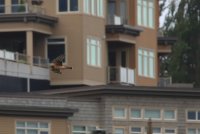
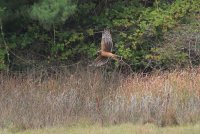
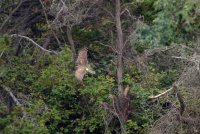
Last shot of the harrier heading south.
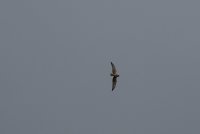
Last shot of the harrier heading south.
Last edited:
After the harrier departed, one of the local kingfishers arrived and made several dives for fish, which gave me an opportunity to test yet another camera and lens combination.
7D + 1.4x teleconverter + 2.8/400L (tripod mounted) = 876mm/35mm equivalent.
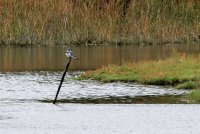
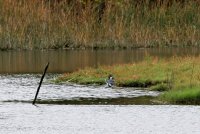
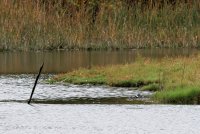
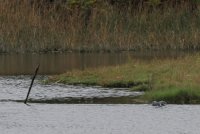
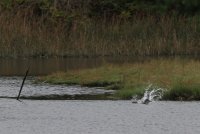
7D + 1.4x teleconverter + 2.8/400L (tripod mounted) = 876mm/35mm equivalent.
Last edited:
Completion of the dive.
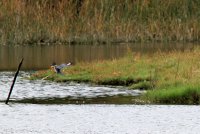
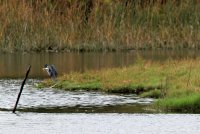
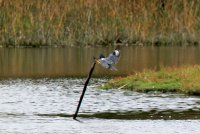
Whatever the kingfisher caught must not have been edible, as it dropped it into the water and made no effort to retrieve it.
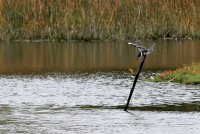
Commentary: With the crop frame sensor of the 7D, this combo is a good compromise of reach and clarity, although you are tied to a tripod. While the 7D has neither the advanced auto focus system of the 5D Mk III nor the 5DIII's ability to handle extremely high ISO settings, it does have a faster shutter rate (8 frames/sec) than the 5DIII (6 frames/sec). Believe it or not, I can sense the difference in shutter rates as I am shooting. At times it can make a difference, like when photographing hummers or birds diving for fish.
At half the price of the 5D Mk III, the 7D is a very good camera for photographing birds; especially in situations where fast auto focus and high ISO settings are not at issue. It goes without saying that if $$$$ is not at issue, pass on both models and get a 1Dx.
Whatever the kingfisher caught must not have been edible, as it dropped it into the water and made no effort to retrieve it.
Commentary: With the crop frame sensor of the 7D, this combo is a good compromise of reach and clarity, although you are tied to a tripod. While the 7D has neither the advanced auto focus system of the 5D Mk III nor the 5DIII's ability to handle extremely high ISO settings, it does have a faster shutter rate (8 frames/sec) than the 5DIII (6 frames/sec). Believe it or not, I can sense the difference in shutter rates as I am shooting. At times it can make a difference, like when photographing hummers or birds diving for fish.
At half the price of the 5D Mk III, the 7D is a very good camera for photographing birds; especially in situations where fast auto focus and high ISO settings are not at issue. It goes without saying that if $$$$ is not at issue, pass on both models and get a 1Dx.
Last edited:
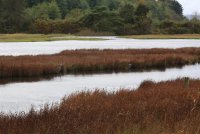
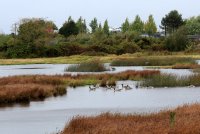
There was nothing special or unusual at the marsh Saturday (9/28), but I wanted to take photos of the high water. Here are some shots I squeezed off between passing squalls about an hour before a really heavy deluge hit town.
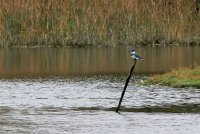
With proper framing, one can take a photo of the marsh with no outward signs of encroaching development and civilization. That pole or stake sticking up out of the water and leaning to the right in the center of the upper third of the photo is the one that the kingfisher was using as a perch in my photos above from the previous day.
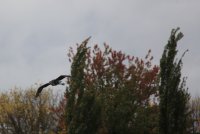
This heron was landing in very heavy head winds.
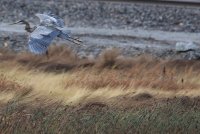
Look at the grass and bullrushes to see what the heron was facing.
A flock of Canada geese shared the marsh with the herons.
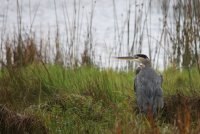
It is very easy to take the marsh's resident great blue herons for granted. I learned from Chris Anderson of the Washington State Department of Fish & Wildlife during his presentation at this year's Puget Sound Bird Fest at Edmonds that our local great blue heron is a distinct subspecies:
http://bna.birds.cornell.edu/bna/species/025/articles/introduction
Unlike the subspecies found east of the Cascades, our local great blue herons do not migrate but stay here to pose for us year 'round.
With proper framing, one can take a photo of the marsh with no outward signs of encroaching development and civilization. That pole or stake sticking up out of the water and leaning to the right in the center of the upper third of the photo is the one that the kingfisher was using as a perch in my photos above from the previous day.
This heron was landing in very heavy head winds.
Look at the grass and bullrushes to see what the heron was facing.
A flock of Canada geese shared the marsh with the herons.
It is very easy to take the marsh's resident great blue herons for granted. I learned from Chris Anderson of the Washington State Department of Fish & Wildlife during his presentation at this year's Puget Sound Bird Fest at Edmonds that our local great blue heron is a distinct subspecies:
http://bna.birds.cornell.edu/bna/species/025/articles/introduction
Unlike the subspecies found east of the Cascades, our local great blue herons do not migrate but stay here to pose for us year 'round.
Last edited:
Fantastic, Bill! You are the master!
Be careful what you say. My head may swell up so large that my signature WSU/Cougar ball cap visible in my avatar won't fit.
Last edited:
Shots from the last day of September. Migrants (both transients and winter residents) are showing up at the marsh.
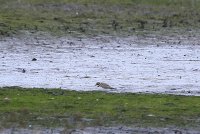
Semipalmated plover. They look like pint-sized killdeer without the killdeer's "bib."
Northern shovelers, one of my favorite ducks.
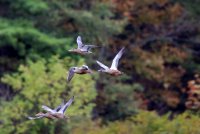
American wigeons.
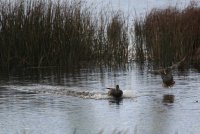
Gadwall.
McEnroe is a permanent resident at the #3 viewing platform.
Semipalmated plover. They look like pint-sized killdeer without the killdeer's "bib."
Northern shovelers, one of my favorite ducks.
American wigeons.
Gadwall.
McEnroe is a permanent resident at the #3 viewing platform.
Last edited:
There was some avian action at the west end of the Pt. Edwards walkway.
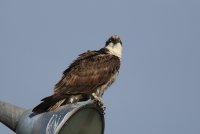
A late-season osprey landed on the old light stand.
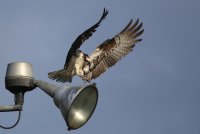
It remained for a few minutes,
then took off.
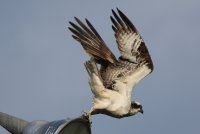
Last Friday an osprey circled the marsh shortly before I photographed the northern harrier. I don't know if that bird or Monday's osprey was a late-staying local summer resident or a bird in transit to its winter residence in Central America.
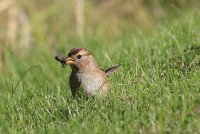
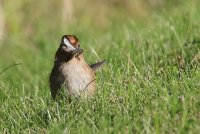
A golden-crowned sparrow took advantage of the abundance of grasshoppers along the walkway. It was with a small flock of 4-5 others.
A late-season osprey landed on the old light stand.
It remained for a few minutes,
then took off.
Last Friday an osprey circled the marsh shortly before I photographed the northern harrier. I don't know if that bird or Monday's osprey was a late-staying local summer resident or a bird in transit to its winter residence in Central America.
A golden-crowned sparrow took advantage of the abundance of grasshoppers along the walkway. It was with a small flock of 4-5 others.
Last edited: